Top-down
Also called bird's-eye, overhead
The camera looks straight down. You see roofs, treetops, and the tops of heads, so walls and faces stay hidden.
- Art cost
- Low
- Hero sprites
- One, rotated in the engine
- Good for
- Shooters, racing, management maps
Learn · Game design
How many ways can a 2D game look at its world? There's no official list, but about twelve views cover nearly every game, and four of them cover most pixel games. Here is one little scene, a house, a tree, and a hero, drawn through each.
The camera hangs above the world. These are the views of RPGs, strategy maps, and shooters.
Also called bird's-eye, overhead
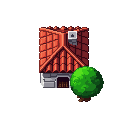
The camera looks straight down. You see roofs, treetops, and the tops of heads, so walls and faces stay hidden.
Also called top-down RPG view
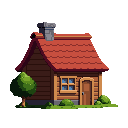
The camera looks down at an angle, so you see the tops of things and their front faces at once. Most games people call top-down RPGs actually use this.
Also called cabinet projection, cavalier projection
Each object's front is drawn flat and true to shape, and its depth slants off at an angle. Strictly speaking, pixel-art three-quarter is a loose kind of oblique.
Also called iso, 2:1 dimetric
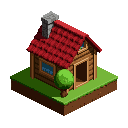
The world is turned 45° and tilted, so the floor becomes a grid of diamonds. Pixel art draws it with 2:1 lines (two pixels across, one up), which makes it dimetric, strictly speaking.
The camera stands beside the world, like an audience watching a stage. Down on screen is down in the world.
Also called side-scroller, platformer view, profile
The camera watches the world from the side, like a stage. Up is up, so jumping and gravity read at a glance.
Also called cut-away, ant-farm view
A side view with the ground sliced open, so you see what's inside: tunnels, rooms, and layers of rock.
Also called beat 'em up view, side view with depth
A side view where the floor is a band, so characters walk up and down it as well as left and right. A shadow under each one shows where it stands.
Also called adventure view, depth scaling
A side view of a room or street where characters shrink as they walk into the screen. You move by clicking where to go.
The camera looks toward the horizon. 2D games fake that depth with sprites that grow as they get closer.
Also called front view, dungeon-crawler view
You see through the hero's own eyes. 2D games fake the depth with pre-drawn wall pieces at a few distances, or with raycasting.
Also called third-person chase, pseudo-3D
The camera rides just behind the hero while the road stretches to the horizon. Everything else is a sprite that grows as it gets closer.
Flat pixel art, placed in real 3D space.
Also called 2.5D, sprites in 3D
Flat pixel-art characters stand in a 3D world with real light and a perspective camera. HD-2D is Square Enix's name for its own take on the look.
Some games never show a world.
Also called text game, interface-only
There's no world to look at, only text, buttons, counters, and bars. Many incremental games start here and add a scene later, if ever.
The diagrams above are simple on purpose. Here is a fully drawn cottage through three of the cameras. Seen straight down, a house is only a roof, which is one reason RPGs prefer three-quarter.
| View | Art cost | Hero sprites |
|---|---|---|
| Top-down | Low | One, rotated in the engine |
| Three-quarter (3/4) | Medium | Three: down, up, and side (flipped for the other side) |
| Oblique | Medium | Three: down, up, and side |
| Isometric | High | Four to eight directions |
| Side view | Low | One, flipped to face the other way |
| Cross-section | Low | One, flipped |
| Belt-scroll | Medium | One, flipped |
| Point-and-click | Medium | Three: front, back, and side |
| First-person | Medium | None: you are the hero |
| Behind view | Medium | The back, plus turning frames |
| 2.5D (HD-2D) | High | Four to eight directions, plus a 3D world |
| No camera (UI only) | Lowest | None |
Two other choices get mixed up with the camera, but any view can use either one: